Water tables constrain height recovery of willow on Yellowstone's northern range
Bilyeu, Danielle M.; Cooper, David J.; Hobbs, N. Thompson. Ecological Applications, 2008
18(1):80–92. Author-hosted PDF.
 Park Vibes
31.3K views
Views updated Oct 19, 2026, from YouTube
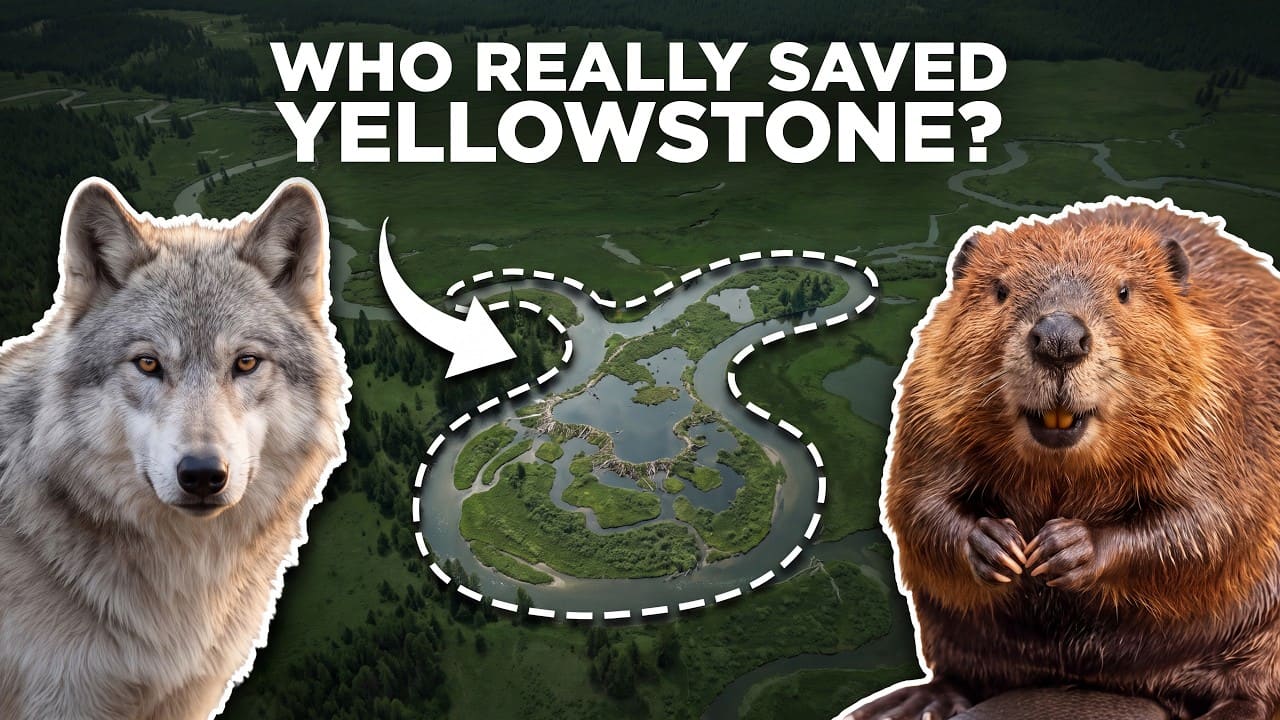
Everyone knows the wolf story. Dropped into Yellowstone in 1995. Credited with single-handedly reviving an entire ecosystem. Immortalized in a video with 44 million views. Nobody tells you about the other animal that got there first, just nine years earlier, with no fanfare and no film crew.
9 sources
11 claims
Every claim below links to the sources behind it. Peer-reviewed research and public records come first.
Forest Service biologist Dan Tyers released beavers into drainages north of Yellowstone (Absaroka-Beartooth Wilderness) from 1986 to 1999, packing them in by horse and mule; he released 129 beavers.
Released beavers moved downstream into Yellowstone, speeding re-occupation of the northern range.
The 1996 park-wide aerial survey, the first near-complete autumn count, found only one beaver colony on the northern range.
Ripple, Beschta and colleagues published in Global Ecology and Conservation (2025) a ~1500% increase in willow crown volume (2001–2020), calling it a relatively strong trophic cascade.
Crown volume was computed from a model based on willow height.
MacNulty, Cooper and colleagues' comment argues the 1500% figure is invalid: a tautological volume model, violated assumptions, unmatched plots and equilibrium metrics in a non-equilibrium system.
Bilyeu, Cooper and Hobbs's experiment: after four years of protection from elk, willows with ambient water tables averaged 106 cm; with raised water tables 147 cm, gaining 19 cm in the last year.
Where long-term beaver absence incised channels and lowered water tables, reducing elk browsing alone may not restore tall willows.
George Monbiot wrote the book 'Feral' (2013).
Elk culling in Yellowstone ended after 1968, and the northern herd grew to nearly 20,000 by the late 1980s.
Beavers reintroduced north of Yellowstone reached Holeman's Meadow by 1988 and Frenchy's Meadow, about 12 km downstream, by 1996. Their numbers leveled off at about 1.33 colonies per stream kilometer around 2000.
Bilyeu, Danielle M.; Cooper, David J.; Hobbs, N. Thompson. Ecological Applications, 2008
18(1):80–92. Author-hosted PDF.
Ripple, William J.; Beschta, Robert L.; et al.. Global Ecology and Conservation, 2025
Short communication, vol. 58.
MacNulty, Daniel; Cooper, David; Procko, Michael; Clark-Wolf, Tyler J.. EcoEvoRxiv (preprint; published in Global Ecology and Conservation, doi:10.1016/j.gecco.2025.e03899), 2025
Preprint page; it links to the published version.
Smith, Douglas W.; Tyers, Daniel B.. Northwest Science, 2012
86(4):276–288.
Beschta, Robert L., Ripple, William J.. Biological Conservation 198:93–103, 2016
Scrafford, Matthew A., Tyers, Daniel B., et al.. Rangeland Ecology & Management 72(2), doi:10.1016/j.rama.2017.12.001, 2018
National Park Service, 1996
National Park Service, 2008
Issue PDF; beaver article with Tyers reintroduction sidebar.
George Monbiot. Penguin
New films and field notes. No spam.