Campaigning for Extinction: Eradication of Sparrows and the Great Famine in China
Eyal G. Frank, Qinyun Wang, Shaoda Wang, Xuebin Wang, Yang You. National Bureau of Economic Research (Working Paper 34087), 2025
 Pack Vibes
167K views
Views updated Oct 19, 2026, from YouTube
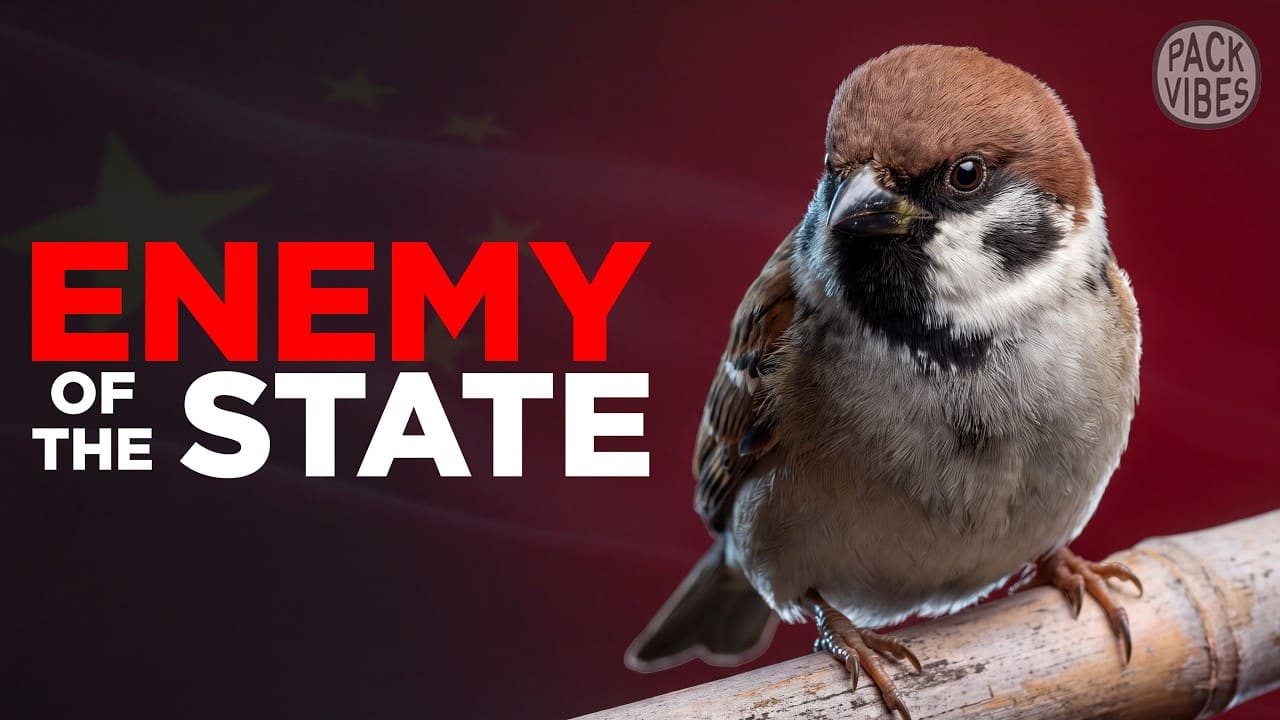
In 1958, millions of people were ordered to bang pots, scream, and wave sheets from rooftops, all so that sparrows would be kept in the air until they fell from exhaustion. In just a single day, officials counted 5 million dead birds. Government figures said they killed nearly two billion sparrows in 1958, and more than a billion again in 1959.
6 sources
9 claims
Every claim below links to the sources behind it. Peer-reviewed research and public records come first.
Officials reasoned that killing a million sparrows would save enough grain to feed 60,000 people.
After the sparrows were removed, locust and other insect populations surged.
The Great Chinese Famine (1959–61) is widely regarded as the deadliest famine in history.
A 2025 NBER working paper by Eyal Frank and colleagues used county sparrow-habitat suitability to measure the campaign's effect.
The NBER paper found that one standard deviation more sparrow suitability meant an 8.7% larger wheat decline and 9.6% higher mortality, implying nearly two million excess deaths.
In 1960, Vice Premier Tan Zhenlin declared the anti-sparrow campaign a success.
In 1960, sparrows were removed from the campaign's list of pests and replaced by bedbugs.
China reportedly imported 250,000 Eurasian tree sparrows from the Soviet Union.
The anti-sparrow campaign accounted for nearly 20% of the decline in crop production.
Eyal G. Frank, Qinyun Wang, Shaoda Wang, Xuebin Wang, Yang You. National Bureau of Economic Research (Working Paper 34087), 2025
Smil, Vaclav. BMJ, 1999
Discover Magazine (Body Horrors blog), 2014
Archived copy (Wayback Machine).
Energy Policy Institute at the University of Chicago (EPIC), 2025
Research summary of the Frank et al. NBER working paper.
The Economist (reproduced by the University of Chicago Institute for Climate and Sustainable Growth), 2025
New films and field notes. No spam.