Rapid physiological integration of fused ctenophores
Jokura K, Anttonen T, Rodriguez-Santiago M, Arenas OM. Current Biology, 2024
 Pack Vibes
13K views
Views updated Oct 19, 2026, from YouTube
Octopi. Mantis Shrimp. Tardigrades. Giant tube worms that have no mouths and live on endosymbiotic bacteria. And an animal that will make you question your definition of what even counts as one animal.
7 sources
6 claims
Every claim below links to the sources behind it. Peer-reviewed research and public records come first.
Other midband rows in the mantis shrimp eye detect linearly and circularly polarized light.
Giant tube worms were first found in 1977 at hydrothermal vents on the Galápagos Rift.
Adult giant tube worms have no mouth or gut and rely on symbiotic bacteria for nutrition.
Siphonophores blur the line between an individual and a colony; they are made of specialized zooids.
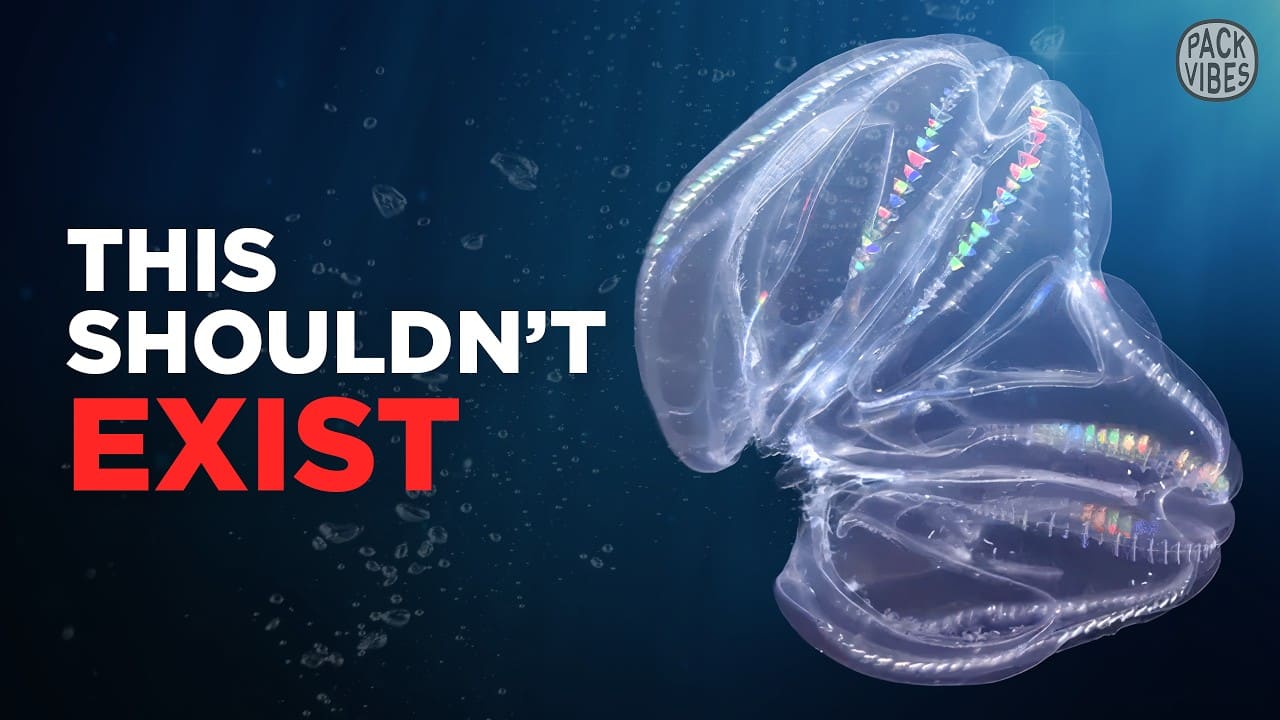
Two injured Mnemiopsis leidyi comb jellies can fuse into a single entity that shares physiological functions.
The mantis shrimp eye has a midband whose colour rows hold 12 types of photoreceptor, covering deep ultraviolet to far red.
Jokura K, Anttonen T, Rodriguez-Santiago M, Arenas OM. Current Biology, 2024
Kleinlogel, Sonja; White, Andrew G.. PLoS ONE, 2008
Bright, Monika; Lallier, François H.. Oceanography and Marine Biology: An Annual Review, 2010
Archived copy (Wayback Machine).
Munro, Catriona; Siebert, Stefan; Zapata, Felipe; et al.. Molecular Phylogenetics and Evolution, 2018
Thoen, HH; How, MJ; Chiou, TH; Marshall, J. Science (New York, N.Y.), 2014
PMID 24458639.
Cronin, T. W.; Bok, M. J.; Marshall, N. J.; Caldwell, R. L.. Philosophical Transactions of the Royal Society B, 2014
Describes the six-row midband and its colour-vision rows.
Smithsonian National Museum of Natural History
Archived copy (Wayback Machine).
New films and field notes. No spam.