Contemporary loss of migration in monarch butterflies
Tenger-Trolander, A.; Lu, W.; Noyes, M.; Kronforst, M.R.. Proceedings of the National Academy of Sciences, 2019
PNAS 116(29):14671–14676; University of Chicago.
 Pack Vibes
45.1K views
Views updated Oct 19, 2026, from YouTube
Half a million monarch butterflies hatch and grow inside mesh cages across America each year. For decades the North American population of these beautiful orange and black insects declined 90 percent. The western population has gone into free fall, crashing 96 percent in a single season, dropping from 233,394 individuals to 9,119.
4 sources
8 claims
Every claim below links to the sources behind it. Peer-reviewed research and public records come first.
Captive rearing and release of monarchs is popular but controversial.
Infected monarchs are less likely to complete migration, and migratory populations carry lower parasite loads than non-migratory ones.
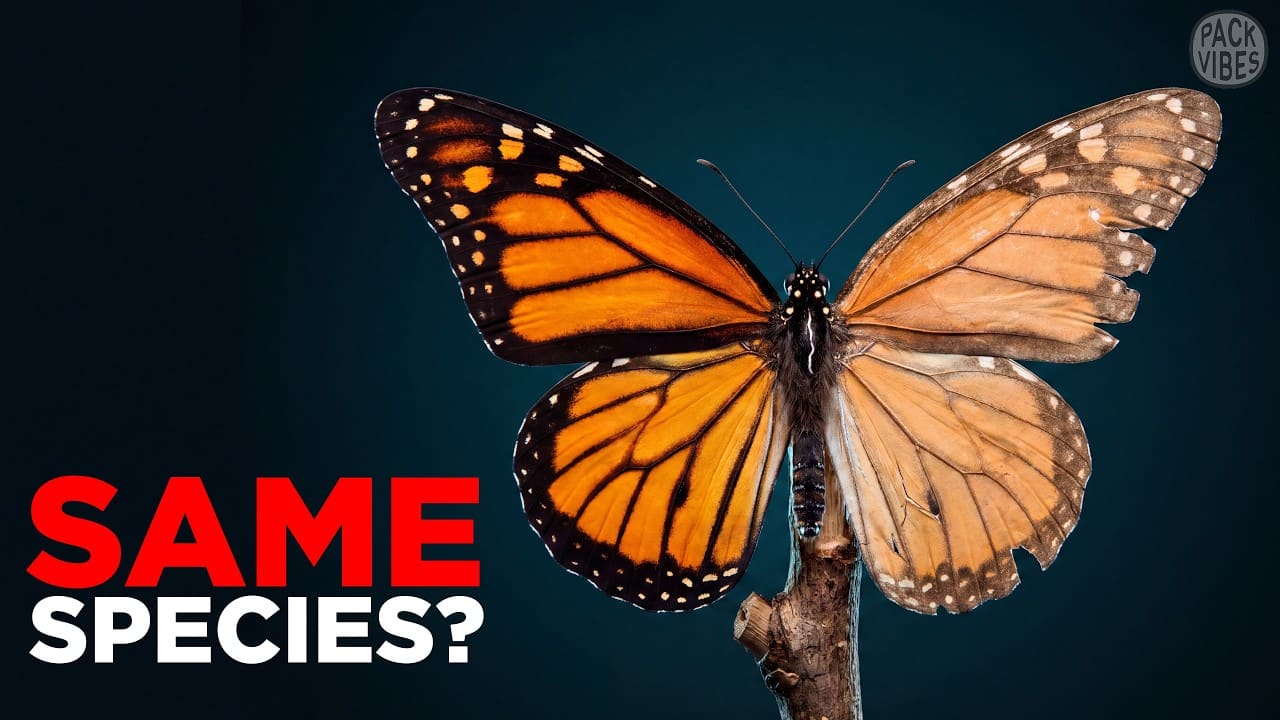
A 2019 PNAS study by University of Chicago researchers Ayşe Tenger-Trolander and Marcus Kronforst found commercially bred monarchs failed to orient south, were genetically highly divergent from wild monarchs, and had rounder forewings.
The same study found that wild-caught monarchs reared indoors also failed to orient south.
A 2020 Biology Letters study led by Andy Davis found captive-reared monarchs had 56% weaker grip strength than wild migrants, plus paler and less elongated wings.
A 2021 Conservation Physiology study found 97% of radio-tracked captive-reared monarchs flew south to southeast, some detected up to 200 km away, even though only 26% oriented south in a flight simulator.
Mexican overwintering colonies covered about 18 hectares in winter 1996–97.
The western monarch count fell to 9,119 in 2024, one of the lowest on record.
Tenger-Trolander, A.; Lu, W.; Noyes, M.; Kronforst, M.R.. Proceedings of the National Academy of Sciences, 2019
PNAS 116(29):14671–14676; University of Chicago.
Davis, A.K.; Smith, F.M.; Ballew, A.M.. Biology Letters, 2020
PMID 32264783.
Wilcox, A.A.E.; Newman, A.E.M.; Raine, N.E.; Mitchell, G.W.; Norris, D.R.. Conservation Physiology, 2021
PMID 34386237.
Bartel, Rebecca A.; Oberhauser, Karen S.; de Roode, Jacobus C.; Altizer, Sonia M.. Ecology, 2011
Journey North (Annenberg Learner), 2016
Archived copy (Wayback Machine).
Xerces Society
New films and field notes. No spam.